This is an excerpt from our Starter Tonk, the welcome page you land on when you open your first Tonk space.
Tonk makes your small software live right away and ready to share.
This is a piece of small software.
Right now, you're using a piece of small software in Tonk. Small software is the type of software that you'd build for yourself, for some friends, or for colleagues.
Small software shouldn't require a database service, an identity and authentication service, a hosting platform and a purchased domain name. You should never have to think about content delivery networks, load balancers or the API layer. These complexities are for the ambition to scale to millions of people; small software has the ambition to be high quality for exactly its purpose and nothing more.
Tonk gets rid of the unnecessary plumbing and, as a result, building in Tonk is fast and easy. I can simply express what behavior I want and it works right away. When I'm ready to share, I run a few commands to push my changes into the Tonk space. If I want to invite somebody to join me in this space, I just click the share button and I'm given an invite link.
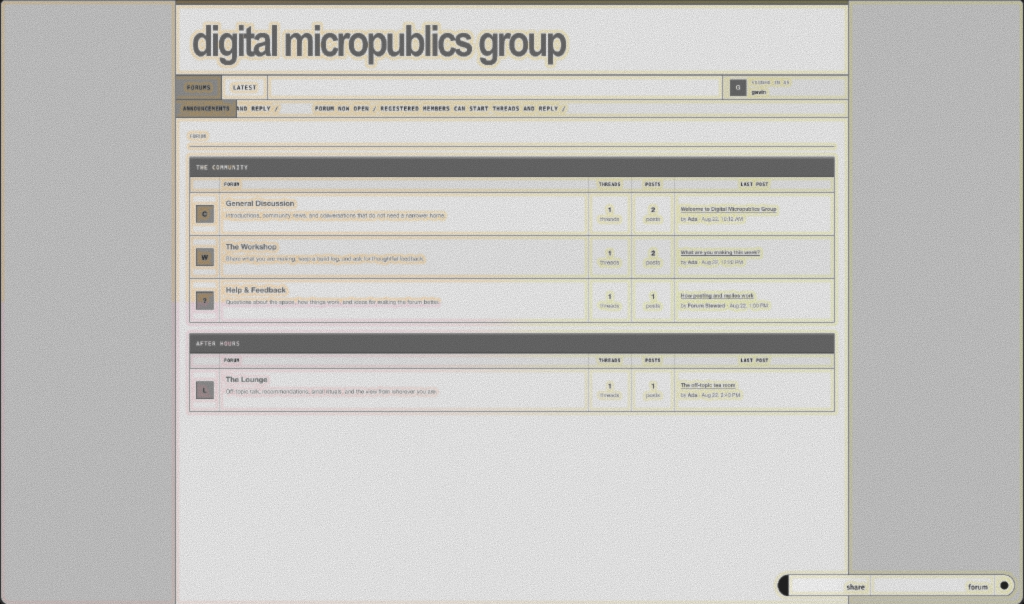
An old school forum built in Tonk was used to generate discussion before and after an event in London on Digital Micropublics

Live software shared like you'd share a Google doc.
If AI makes software simple to build, shouldn't it be simple to use together too? We dream of an age of small software, just-in-time software, bespoke to you software. It's a digital library of audiobooks you share with your mom. It's an application for the team to vote on when and where to go to lunch. It's an agentic multitool shared within the ops team.
How do the software paradigms of today break in a software explosion?
Small software is weighed down by the paradigms of SaaS architecture. In order to unlock abundant small software, we must adapt to a world where instead of using a few big, expensive apps on a daily basis, I might use hundreds a day, thousands a week, or maybe even hundreds of thousands over a year.
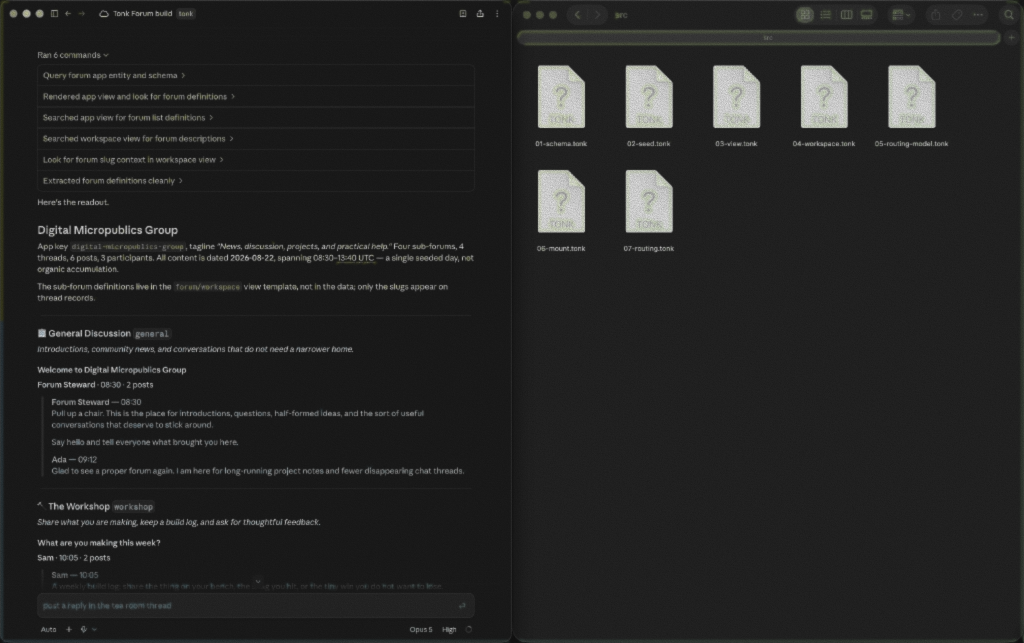
Our micropublics forum is defined by only seven files. My agent pushes the changes with couple commands. Share links for invites are minted in the menu bar.
Flip the model of software to be local and small again
Imagine big software as a factory that needs its own power station, rules and roads. Whereas small software in Tonk is more like a house in a local neighborhood. Each house shares a public road, set of regulations and electricity grid. It would be absurd if every time you wanted to build a new house, you also had to also create a new power station, new laws and a new set of roads. If we fix the base layer as a shared system, then it's trivial to add and remove hundreds or even thousands of pieces of software without disruption.
In Tonk, you hold on to your data and identity. The software comes to you.
Each new piece of software stops becoming a world of its own and instead becomes an interface into your world. Tonk is organized into spaces, which are containers of data and are the shareable unit of Tonk. When you bring a piece of software into a space, it extends the space and becomes a view into the data underneath.
You can synchronize tonk spaces to your machine through the CLI, so the data is always going to be available locally and all data access is signed by you alone, so it stays under your cryptographic control. Tonk services are designed to act as a relayer (dump pipes) like the electricity grid.
And connecting your agent into a Tonk space is just as simple as sharing it with another person.
Tonk is a native medium for agents. All data has an address in the system. So, even if you know what an API is, you won't need that to access data in a space. When you give your agent a share link, they set up a connection through the CLI and start to read and write to the space by using the system just like humans do. In fact, this is how agents build software in Tonk!
Data in a space is like a big soup. It has no imposed structure; each entry exists as an atomic element. Every piece of software or process expresses a view over those elements. Each client pulls out bespoke structure by defining what it cares about during query time. But in the end, all changes merge back into the same shared soup.

Now we can set software free.
We forget the personal computer was a radical invention. PBS's Triumph of the Nerds, when speaking of the 1975 Altair 8800, exclaims "the question is, what do you do with it?" At the time, it was a hobbyist machine; a fancy calculator. But early enthusiasts of the personal computer understood that most special quality of the personal computer: you could play when no other computing machine could let you play because it was too expensive.
That free space gave us digital art, electronic music, spreadsheets, digital publishing, computer games and more. What unexplored possibilities exist when digital collaboration no longer needs to feed an industry to secure its existence?
Maybe all those applications you loved that went out of business, will come back into your life, because small software can be playful and needs no justification for its existence beyond its value to you.
Explore that possibility with us, by making a free account, building into a Tonk space and sharing it with others to create your own world.