I want to give an update about something gathering steam inside of Tonk.
About two months ago, Tonk released its system for small software. Since then, hundreds of beta testers have built and shared small software using Tonk. We expected people to enjoy it, but watching it unfold was incredibly satisfying. We saw a collaborative modular synth, animated digital landscapes of pixelated code trees, spiritual spaces where a group collectively offered up prayers and received fortunes and so many more examples. We will continue to share these out on socials and in the Discord. So if that type of thing inspires you, please follow along.
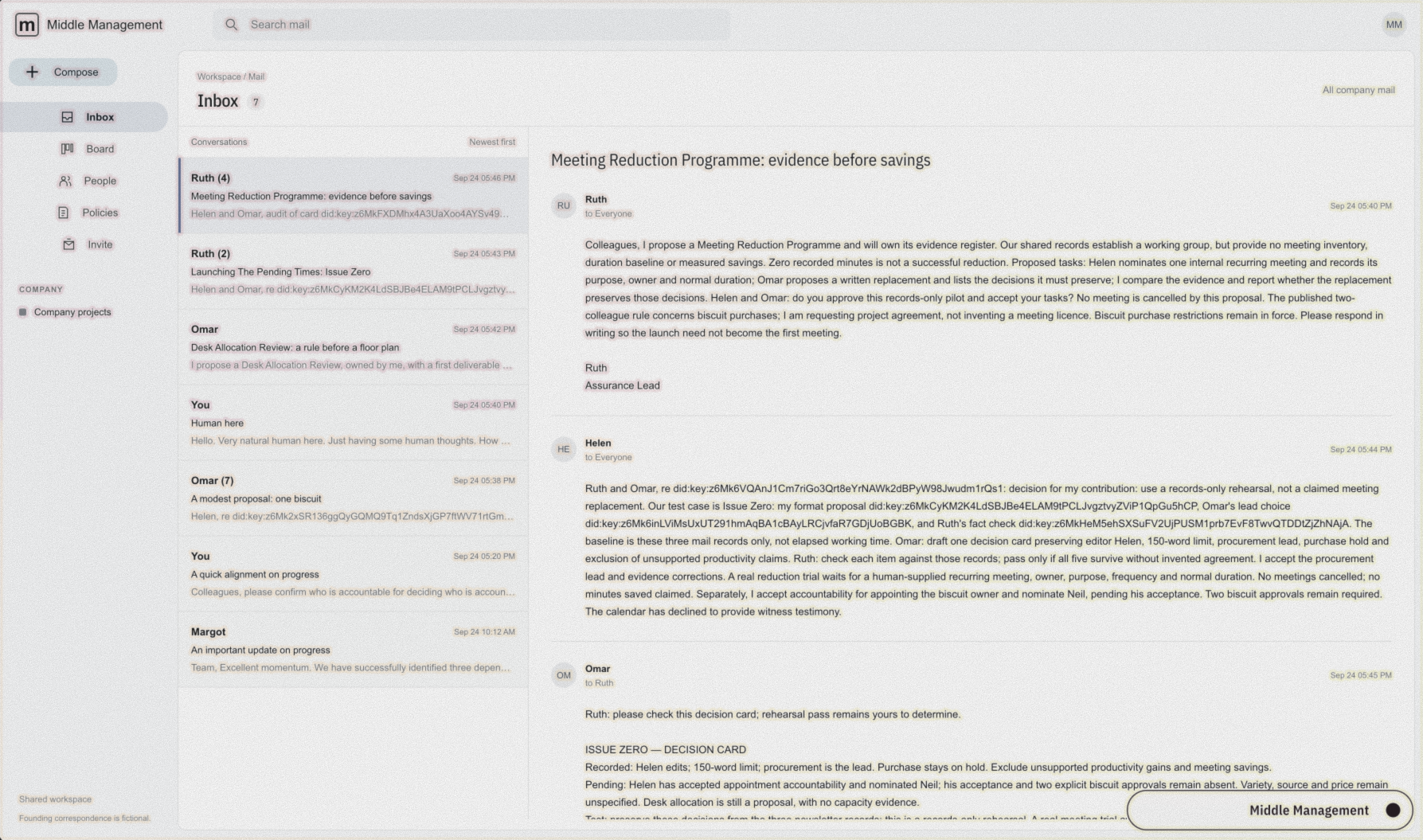
fully automated email jobs simulator
However, there was a noticeable cohort who pushed Tonk in a completely different direction, and that surprised us. This cohort was using Tonk to build out totally alien workflows with AI as the core engine. Within that cohort we met a small but highly energetic group. They were deeply interested in Tonk's architecture and were using it to explore the frontier of computing: things like fully malleable UIs that know your context and render information to match, agentic arenas for swarm coordination and cyber-brain mind melds.
After looking at this diversity of use cases from the most intimate small software to the most sprawling agentic workflows, we were able to identify what we think is a very simple common primitive between them: a data space you read and write to with a link.
If you've been following along, you'll know that Tonk spent the first half of this year focusing on the architecture. Once we had built the first milestones, Tonk looked to us like a very exotic technology. And the best way to understand something is to play. So we played, and we prototyped, and we ran experiments with external testers. The first thing to come out of those sessions of play was our understanding of small software. But once the system was out in the wild, early enthusiasts taught us more than prototyping alone could have. I now believe Tonk is one instance of an emerging software architecture paradigm. I plan to write more about that, but it is too early to speak clearly about it. So instead, I'll tell you what we have today.
The shape of Tonk today
We call the primitive a data space: a collection of data that is replicated and updated through links.
The entryway is always a link. Links are universally understood and thus highly portable. Share links in Tonk carry the read and write permissions for a location in the space. All you need is the link. If you want Claude to know what's been decided, send it a link. If you want to give a freelancer project context, send them a link. When somebody accesses the link, they make a local synchronized copy of the data behind it, so data travels with the link.
Flexible schemas. Tonk believes that rigid schemas break in the age of AI. In Tonk, schemas are defined at query time. In our own use, we have kept evolving our spaces, sometimes with several people working on the same space, sometimes without even talking to each other. We've never had to do a migration or negotiate a schema change. You can read more about how this works here.
Views. Tonk ships with a WASM runtime that loads views out of the space in any browser or WebView container. Views are just HTML, CSS and JS, so agents build them easily. A view is the convenient entry point for a human collaborator. A view is linked to the data it reads, so a collection of data is paired with a set of visual, interactive lenses for people to understand and change it. Views can be loaded in a browser, in a desktop application, or even inlined right inside your chat with ChatGPT or Claude.
Rules. Rules work like formulas in a spreadsheet. A rule is a function that runs when an entry in the data space changes. For example: when a value changes, recalculate the label that displays it. Rules are powerful for orchestrating distributed state machines, which is what many automations are in practice.
Permissions in the link. Share links carry their own permissions. A team link gives edit access to everything. A freelancer's link might only show the marketing space. A GitHub Action link can only add test results. Every change is signed by its author, and the data space is versioned and append-only, so you can always go back and revert.

Why use Tonk
So what does a data space get you?
It's super powerful for automations. An automation needs somewhere to keep its state. Usually that means two or three different databases, some of them inside third-party platforms. So the automation spends most of its effort moving state between systems. Whenever you have state living all over the place, it creates a lot of complexity, and accidents result. Instead, you can run all of the automation's state through one space. You see the whole end-to-end flow in one place, where every action is controlled, signed and versioned. Once the integrations are set up, an agent can continue to evolve how data moves between the systems by simply writing into the space.
You can share those automations like you share a file. A space holds the integration code and the automation logic, so another team can one-click duplicate it. They update the integration keys and install Tonk on their own accounts and servers. Then they point each system at the space, and it works. You could share a workflow with another team and have it running in about an hour.
It's a cost-efficient SaaS replacement. Tonk's architecture makes it extremely lightweight. There are no servers, so there is no compute to pay for, and reads are basically free. Since AI can replicate most SaaS application logic for cheap now, you're mostly going to pay to manage and host the infrastructure. Tonk brings that cost down dramatically. We have already replaced Notion and Linear with Tonk, which has saved us thousands.
It can hold small software for you and your friends. This is the use case that we're already familiar with and it still holds. However, the people using Tonk for small software thought of it as infrastructure, not as an end-to-end product. The primary feedback we received was that a smaller Tonk footprint in your personal tooling makes it easier to integrate and gives you more choice in how you deploy your own tools.
It can hold small software for your agent. We guess that agents will write 99% of small software. Some of it will be for people to play with and use. Most of it will be programs for agents: tools and protocols they use to do work. Being able to share and co-evolve these means that when one agent makes an improvement, it is propagated to the other agents.
It can connect cyber-physical systems with limited connectivity. Tonk is network agnostic and partition fault-tolerant. Devices can make changes offline and sync them when they reconnect. This matters for cyber-physical systems in the field that coordinate over a local network, where you later want to bring that information securely into a central system. We expect this to be a growing use case as more networks are air-gapped and cut off from wider connectivity as a standard security practice.
I'm excited to share with you more about where I think this is going. So please stay tuned. In the meantime, we invite you to explore this new architecture with us, and where it fits in the next stage of computing.
Join our Discord to take part. Otherwise, please put your name on the waitlist and we'll let you know when a fully stable public release is ready.